Friday, July 12, 2013

Hot Wheels and High Heels by Jane Graves

Skeptic scale: ♥♥

He: An ex-cop, now a repo man. Loner. Tough guy.

She: Blonde. High maintenance. Ex-trophy wife to an embezzling jerk who has absconded and left her holding the bag. 

Conflict: He's just doing his job when he comes to repossess her fancy car, but she's not taking it lying down. She's seen everything she owns be taken away from her in front of her eyes and she just wants to keep ONE thing - her beautiful car. And maybe also a bottle of outrageously expensive wine. They are at cross purposes but she needs a job and he needs a secretary and boom! It's on.

Sooo... I liked the general premise of the book. It was pretty fun, fast paced and a little different from the usual stuff. 


Specifically, I liked:
1) Blue-collar hero who's plenty alpha, but also a nice guy. I don't get to read a lot of blue collar hero stories - and the ones I do, I usually find a bit silly, because the hero can never just be a regular middle-class guy - he's always a contractor who owns his own business, or a chef who owns his own restaurant, or a hot shot detective who doesn't play by the rules. This guy is a repo man - NOT a typical career choice for your dream man (and come to think of it, yeah, he does own his own business), but he's not necessarily running this smooth, money-making enterprise. It's just a regular business, making a regular living. So that was definitely new.

2) I liked that the story focuses on older people falling in love. Again, not something I typically read, so it was something interesting and different for me.

What I thought was dumb: 
1) There was a real lost opportunity here with the poor little rich girl + blue collar working dude interaction. I feel like because the characters were a bit older (in their 40s), we could have maybe seen something a little more nuanced about how the differences in their relative wealth had guided their life-choices. Like, maybe she could have done something useful while being a trophy wife of some rich finance type? Instead, she is just the same old spoiled, vapid creature we hear about on the Real Housewives of Everywhere Hot and Sultry. Meh. 

And maybe the story could have shown how, even though he wasn't necessarily rich, he is still doing something valuable with his life. He also seems sort of defensive about how he isn't filthy rich like her ex-husband. Defensiveness is not hot, my man.

2) I thought the writing, while snappy, was a little on the sit-commy side. Lots of situational stuff that was supposed to be funny, but I think I prefer humor that comes from language rather than a "comedic" situation. Personal preference.

Skeptic's last word: So I liked the writing, liked the plot and kinda liked the characters, but I just thought it was all too silly. The tone was a little too hammy for me to really engage with the characters and I spent most of the time rolling my eyes and how dumb the female lead was. But I have another one of Jane Graves' that will give a read and see whether I still feel that was about the style.

Thursday, July 11, 2013

Bridesmaid Lotto by Rachel Astor

Skeptic scale: UNF

Couldn't finish it. It was incredibly 2-dimensional and silly. I don't have the energy to say any more. But I will.

The premise was great actually! The main character wins a lottery to become the bridesmaid of a famous socialite. I'm actually shocked this isn't an actual concept for a reality show. 

America's Next Top Kardashian?
The Real Blondes of Shotgun Island?
Snooki's Next Top Cat Fight?

Unfortunately, it was like all the originality got used up in the premise and the rest of it reads like a amalgam of every girly girl cliche ever written - gay best friend, endless gossippy passages on clothes and makeup, wedding, wedding, wedding stuff. I should have figured, given the title but honestly, I was just WRUNG OUT.

I also found the writing and grammar to be appalling. All stuff that a good edit should have caught...

Skeptic's last word: I guess this was a nice, fluffy read for a person who enjoys a lot of girly stuff. I don't know if this is the BEST example of chick lit, but I guess it may work for some readers.

Monday, July 8, 2013

Austenland (2013) - coming soon!

Jane Austen + Rom com + British actor candy = Oooooh mama.

Austenland is about a girl who is so obsessed with the world created by Jane Austen that she books herself on an immersive Regency holiday at a beautiful English manor to meet the Darcy of her dreams.

This showed at Sundance at the beginning of the year and was directed by the co-writer of Napoleon Dynamite (so you know it's going to have some mad quirk.)


Here are the release dates (all 2013):
Jan 18 - Sundance (premiere)
Jun 29 - Nantucket Film Festival
Jul 13 - Maine Int'l Film Festival
Aug 16 - LA & NY
Sep 27 - UK

I feel kinda bad for the producers of films like this. I mean, you're milking the teat of the Darcy archetype to feed a seemingly never-ending appetite for all things Jane (and Colin Firth, obvi). Like taut-bellied piglets, we feed hungrily at the swollen udders of mommy pig, squealing with hysterical joy, our hopes, like our curly tails, impossibly high. 

At best, when we're done with a movie like this, we feel a sense of pleasant satisfaction, rolling over like overfilled sacks of barley, sated (for the moment) and placid. At worst, if the movie doesn't deliver the movie producers can expect some severely chapped nipples. There's nothing worse than a bad Jane movie.

Given the risk of grave disappointment, will I still watch this? Um, am I a living, breathing female with some unresolved Darcy fantasies?

Here is the eye candy and potential love interests for Keri Russell's main character:

I Do (But I Don't) by Cara Lockwood

Skeptic scale: ♥♥♥

She: Junior wedding planner with a terrible hag of a boss

He: Firefighter

Conflict: Hmmm... not really sure it was a conflict. More like a "omg, I really like him, does he like me too?" Cue: series of misunderstandings that keep H & h apart for much of the story.

What I liked:
1) This is the exact kind of book publisher blurbs call "beach reads" and that's exactly what it was - lighthearted, easy peasy fun where I didn't have to think too hard

2) This is a weird thing to call out, but I really liked the fact that the story was set in a city other than NYC/LA or Generic Small Town in the Heartland. Instead, it was set in Austin, Texas - a nice sized, interesting city that we don't get to see all that often in these books. The NYC/Generic Small Town thing always leads to these caricatures of Big Bad City Gal/Perfect Wonderful Heartland Folk that have begun to really irritate me. And the Big City romances always show this bitch/career woman pairing that I find tiresome and unfair to career woman, nay ALL women. So this was nice.

3) First person was used well. You get enough of an idea about the H because of their conversations and we were not at all left in the dark about his motives, wants and hopes. It was generally entertaining to get to see the romance unfold through her eyes. Having said that though, I need to mention that Kristen Higgins does such an amazing job of first person that everyone else's looks like watery porridge next to hers. Still it wasn't terrible.

What was meh:
1) What would you think if I told you that this was a story about a wedding planner who has a crush on this dude but it looks like she might be planning his wedding thereby making their love impossibly impossible? 


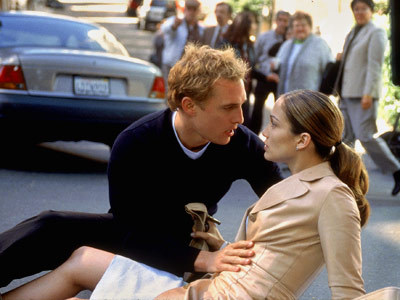
Right? Obviously. J-to-the-Lo co-opted this story and even if this book came out before the movie did (not sure if it did), the inescapable truth is that this is the image that popped into my mind the second I figured she was a wedding planner. Unfortunately, my regard for Ms. Lopez does not extend to her acting skills, so this was a terribly unfortunate image lurking around in the background.

2) You can't base an entire story on a series of misunderstandings. You just can't. I think readers just want more. When the entire "conflict  can be solved with a single conversation/voicemail, I feel like it's a little silly that the Scooby Doo stuff continues for so long. 

*Spoiler* In "I Do (But I Don't)" it's cute in the beginning but then the h & H spend a whole weekend together and it never once comes up that "hey pretty lady, I'm not the one getting married, here's my deal and we're free to get it on?" *End of Spoiler*

Lack of communication is bad for relationships. Dr. Phil would be so disappointed.

3) I thought it was weird but cool but then weird again that the hero is described as being Too Good To Be True (and what did our mom's tell us about things that look too good to be true?) Turns out that this hot, amazing dude is also SUPER nice is because he used to be fat. Oh, I know it doesn't say that explicitly! It's more like the h wondering, hmm HOW COME this guy is so awesome? And then she find out this fact about his prior chunkiness and then it all makes sense and she's like oooooh, he must be for real then. 

Shorthand way of saying he's nice because he was insecure once and doesn't inflict that shit on anyone else. You see? It's nice. But kind of also weird.

Final word: Nice, time pass book, with some amusing bits and and ok setting/premise. Just be warned that it's pretty heavy on the cliched storylines and characters, but I didn't hate myself after reading it.

The Guernsey Literary and Potato Peel Pie Society by Mary Ann Shaffer & Annie Barrow

Skeptic scale: ♥♥♥♥

What a lovely little book. I call it "little" only  because it made me feel like I was in a cozy little world containing just me and the 15 odd characters from the book writing each other letters and chatting over our knitting.

The story is revealed through letters and telegrams to and from the "narrator", the journalist and author, Juliet Ashton. There are a few bits of correspondence between other characters in the book talking directly to one another, but mainly the story is about how Juliet learns of the experience of the inhabitants of the Channel Islands during German Occupation of the islands during WWII. She grows to love the people with whom she corresponds and even moves there to immerse herself in the Guernsey experience.

There were several things I thought were a little odd about the book:
1) The fact that all the letters are written in the same "voice" - the pig farmer's letter sound almost exactly like those Juliet writes, and those bear strong resemblance to the letters written by the Juliet's publisher.

2) Juliet ends up adopting a 4 year old child after knowing her for what seems like a matter of months. Not sure how that would even come to pass...

3) Spoiler! The main "romance" happens between Juliet and a pig farmer. But apart from their initial correspondence where they talk about poets, and then their casual talks about the history of the Guernsey and books, they don't really seem to really know a whole lot about each other.
That's the trouble with this "letter and note" format - everything we know about the characters is confined to these snippets and anecdotes - which can get frustrating if you want to get a real sense of character and motivation. End of spoiler.

4) I was expecting a lot more trauma and angst in the characters. I mean, these people just 
spent a few rather horrific years being imprisoned in their own home and treated like slaves, they know close friends who have been brutalized by the Nazi campaign. But everyone seems to have suffered nothing more lasting that a general sense of sadness and melancholy. There are a couple characters who are worse affected, but those seems like outliers rather than the norm.

5) The characters all seem a bit "caricatur-ish" - like there a meddlesome old woman, a stoic and stalwart farmer, a drunk, a termagant spinster who hates "fun", a crass and confident American, a lovely and appealing main character who seems to be universally adored and who effortlessly attracts men wherever she goes. And so on...

6) There is reference to this one "special" character from the island - Elizabeth - who is painted as some sort of saintly Madonna that I found to be rather a stretch. I think we are supposed to feel EXTRA sad about how she was sent to a Nazi prison camp because she was such a wonderful person. But I thought she was a little too perfect to be a believable character and you almost feel like it was unnecessary to show her as such. It would have been sad enough that she was sent to a camp if she were just a regular person - she didn't need to be a saint for me to feel bad.

Ultimately though, these things didn't change the fact that I did enjoy reading this book. The writing was witty and easy to digest and despite some of my criticisms above, I did begin to care for the characters.

What I liked:
1) What I enjoyed most of all was the writing. There were some wonderful, easy-on-the-ear snippets and clever little turns of phrase that had me smiling often.

2) I didn't know much about the Channel Islands and the islanders' experience during WWII so I learned something new about the war and it gives one good perspective of how far reaching the effects of that horrible time were.

3) I thought the love story (although a little unbelievable) was really sweet.

4) I liked the contained little universe created by the letter writers - it makes you feel like you're on an island yourself, far away from everything "real", like bombed out buildings or concentration camps. 

Friendly little quotes that I highlighted while I was reading: 
"That's what I love about reading: one tiny thing will interest you in a book , and that tiny thing will lead you onto another book, and another bit there will lead you onto a third book. It's geometrically progressive - all with no end in sight, and for no other reason than sheer enjoyment"

"I much prefer whining to counting my blessings"

"I can imagine their entire lives from a glimpse of a bookshelves, or desks, or lit candles, or bright sofa cushions."

(Of bookshop owners) "...clever customers ask for a recommendation...whereupon we frog-march them over to a particular volume and command them to read it."

 (Of a character's trophy shelf) "There were statues for everything a man could jump over, either by himself or on a horse."

"...as a token of our long friendship, you do not need to comment on this story - not ever. In fact, I'd far prefer it if you didn't."

(On the efforts of a particularly persistent suitor) "So far, his blandishments are entirely floral"

"'Life goes on.' What nonsense, I thought, of course it doesn't. It's death that goes on; Ian is dead now and will be dead tomorrow and next year and forever."

"The Mind will make friends with any thing."

"I sat; arms crossed, hands tucked under my armpits, glaring like a molting eagle, looking around for someone to hate."

"Light griefs are loquacious, but the great are dumb." Quote from Roman philosopher Seneca

"[She] believes in breaking the ice by stomping on it."

Sunday, July 7, 2013

Bound by Your Touch by Meredith Duran

Skeptic scale: ♥♥♥

He: James is the rakish heir to the Earl of Moreland whose sole aim in life is to infuriate his father in order to "punish" him for this terrible thing his father did in the past. James never forgives his father for abandoning his sister during her most difficult time because of the Earl's obsession with being dignified in the eyes of society. 

She: Lydia is a proper, spinsterish miss who for lack of a "better" occupation (i.e. marriage) is her father's right hand man in his business affairs in the trade of Egyptian antiquities. She doesn't seem to have any special passion for antiquities for all she writes papers about them, but she does do her duty to her father admirably.

Conflict: Both H & h are loyal to a fault. Lydia is loyal to her father, despite the fact that he basically abandons her and her sisters to hare off to Egypt to dig up artifacts. James is loyal to his sister even when it means ruining his relationship with his father, ruining his own reputation in society and generally living with his sweltering bitterness and guilt. 

Eventually both are made to see that loyalty and faith, while excellent attributes, cannot be given indiscriminately. Lydia and James each need to give up a little of their stubbornness in order to face reality and finally learn to be happy.

What I liked: 
1) I liked the psychological complications of relationships between fathers and their children. It shows how those initial key relationships with one's father/mother teach people to love and trust in future relationships. When those initial relationships go wrong, it can have devastating effects on the person's ability to really achieve true peace of mind until they resolve the conflicts with their own families.

In the story, it is imperative for both Lydia and James to achieve some sort of closure with their respective fathers before they can truly be free to forge a new, healthy relationship with one another. I appreciated the fact that the author didn't try to resolve everything with a pretty ribbon at the end, but left in a little of the messiness that a real life family with internal troubles might have.

2) The writing was amazing. Sometimes. 
MD would write these beautifully complicated sentences, witty dialogue and some lovely, wrenching internal character monologues, and then she would have a sentence like "you, sir, are a cad!" Huh? Seems a little trite, no? Then there were these awful, awful, awful American-isms ("bully for you") that just made me wince. And many times characters refer to James as "Viscount" rather than "My lord". There should be a proper editor who edits this kind of stuff out. I mean, I know it's not THAT big a deal, but if you're writing a period book, why not just treat the topic with respect and do it properly?

Anyway, MD is clearly a wonderful writer. But I thought this was only good when it could have been edited to be superb.

What I grew super annoyed with:
1) Lydia spends a whole lot of the book chastising the poor man for being a "cad", being useless, being a rake, being a bad son etc etc. Get over it, lady. It was especially annoying because she seems to go overboard criticizing him because she herself is such an insecure bundle of nerves (she's insecure about her looks, her standing in society, her desirability). And anyway, who was she to criticize someone so roundly? She was plenty damaged herself.

2) Although everything was really well written, I felt like the internal monologue just went on and on and ON. There were some points where one character would say something, and before the other responds there would be 3 PAGES of internal monologue - so I had pretty much forgotten what the last bit of dialogue even was by the time the other person responds. 

3) Throwaway secondary characters. Lydia's sisters, James' friend Phin and certain other secondary characters are mentioned, play some role in the story and then sort of just disappear. We don't get a sense of the "world" Lydia and James live in because we don't really know the people in their world. We know a lot about their relationships with their respective fathers, but very little about their relationships with other people. Even Lydia's relationship with her sisters seem a bit two-dimensional. All I know is that one sister sucks and one is nice. And that's about it. MD probably set it up that way to write other books about these other characters, but I thought their roles were a bit unsatisfying in this particular book.

Skeptic's last word: I think MD is a super writer - she seems to be someone I would normally love reading. I am going to pick up another of her books to see if I perhaps just picked wrong this time since this seemed to miss somewhat with me. 

A Lady Awakened by Cecilia Grant

Skeptic scale♥♥♥♥

He: the wastrel son of a baronet who's been banished to the Sussex countryside to behave himself. He's a good-natured, affectionate sort who misses his uncomplicated London life of fun and easy manners. But to end his banishment, he needs to prove to his father's steward, and by extension his father, that he has become a respectable land-owning gentleman and has left the life of dissipation behind him. 

The task becomes especially hard when his very pretty, very widowed neighbor makes him an offer impossible for a cad like him to refuse. Not that he wants to refuse.

She: The widow of a man who was rather careless of his lands and responsibilities while he was alive. She took on all the responsibility of running the household and oversaw the duties to their tenants and lands. But now that her husband has died without an heir, the land and life she regards so highly will be lost to her dead husband's villainous brother. She cooks up a plan to find an "heir" in a month by recruiting the H to be her hired stud. Wha whaaaat!

Conflict: She's prickly, proper to the point of being tedious, and entirely without the capacity to charm. She's single-minded in her goal to fake an heir because she knows if the property gets into the nasty old lech of her brother-in-law's hands, he will be a threat to the virtue of every female servant and she just can't let that happen. She thinks the H is vain and silly and has little respect for him, even though she needs his help to conceive. She hires him to be her "stud" for a month in the wild hope that she can keep the property but remains entirely aloof to his charms.

What I liked:
1) Considering that the construction of the story required 30 days of sex scenes I was worried that it would all get a bit comme ci comme ca by the nth description of their heaving bosoms and trembling nerves. 

Noting could have further from that expectation! In fact, for most of the book there were no heaving bosoms! The heroine remained frigid and unresponsive to his bedroom blandishments for the majority of their doing-it scenes. I thought it was hilarious that the only times she felt turned on by him he wasn't trying to seduce her at all - it was during totally serious moments where was talking about wheat prices or being "intellectual" or when he being useful and fixing a tenant's roof. 

2) There was some actual character development - as in both characters developed into richer, more complicated people as the story progressed and began to like each other as they saw and learned more of the other. 

There was an interesting juxtaposition of this puritanical, "innocent" friendship that grows between them, while they're conducting this strange, rather scandalous physical relationship where neither is getting all that much pleasure. Usually romance novels present stories the opposite way - beginning with this explosively amazing sexual chemistry and using the rest of the story to develop an out-of-bedroom relationship between the characters. This sort of turns that formula on its head a bit because there non-sexual chemistry actually grows a lot faster and their sexual relationship has to catch up.

What I thought was a bit weird:
1) It seems sort of a stretch to think that a prim, governess-y lady would approach a random dude to hire him to be her stud. Pun intended. Why not just travel somewhere and adopt a baby? I get that she was desperate and things needed to be done really quickly so the baby seemed legitimate - but surely there were other ways to deal with the issue that didn't involve sex with a total stranger who has a reputation for being a philandering rogue. Did no one fear the pox in those days!? Seriously though, why wasn't adoption a viable option?

2) Why does he try so hard? It becomes clear from the first few interludes that she wasn't getting any pleasure out of his bedroom skills. This sort of compels him to try even harder, going to even greater lengths to see that she derives pleasure from their little interactions. To no avail. In fact, she just sort of acts holier than thou the whole time because she considers him useless and directionless. Um. He's not the one hiring someone to fake an heir so I feel like her feeling of superiority was a tad misplaced.

I see why he would be intrigued by her initial suggestion and go with it for a lark. But then when she proves to be a pain in the butt, why doesn't he just end it? Wouldn't a guy just feel kind of demoralized after day 5 of frigid reception? She's not very likable in the beginning so not sure why he decides to keep going? The way it's described in the book, he is determined to turn her on with his legendary bedroom skills and needs to prove to himself that he can. I call bullshit. 

Skeptic's last word: Anyway, despite a couple of over-engineered plot points, this is a fun, craftily constructed story. CG cleverly weaves in so much more than a love story here - we talk about the rights of women during the times, the politics of land ownership and the social politics of the co-dependent role of landowner and tenant. The love story wasn't as dark and intense as the other one of hers I  loved (A Gentleman Undone) but all in all, a good read.